


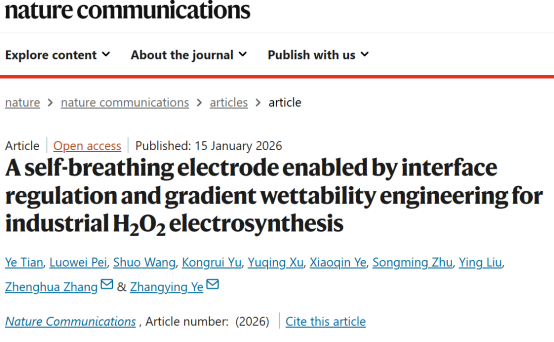
Recently, Epai Tech in collaboration with Zhejiang University and Tsinghua University, published a research paper in Nature Communications titled “A Self-Breathing Electrode Enabled by Interface Regulation and Gradient Wettability Engineering for Industrial H₂O₂ Electrosynthesis.” The study systematically proposes a complete solution for hydrogen peroxide electrosynthesis, ranging from paradigm innovation at the interfacial level to comprehensive structural system reconstruction.
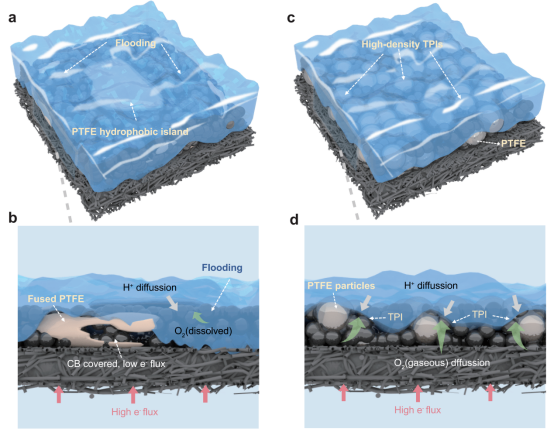
At present, the electrosynthesis route for H₂O₂ based on the two-electron oxygen reduction reaction (2e⁻ ORR) shows great promise. However, its industrialization has long been constrained by the “flooding” phenomenon occurring in gas diffusion electrodes (GDEs) under high current densities, which leads to collapse of the three-phase interface and a sharp decline in Faradaic efficiency, severely hindering commercialization of the technology.
For decades, researchers have primarily focused on catalyst modification, pursuing ultimate selectivity and activity in what resembles a “100-meter sprint” conducted under ideal laboratory conditions—competing for the highest initial performance. Real-world applications, however, are more like a “marathon,” requiring long-term operational stability and endurance.
Although some studies have recognized the critical importance of the three-phase interface and attempted to strengthen the interfacial reaction environment through hydrophobic binders, a practical limitation remains: hydrophobic binders such as PTFE exhibit a threshold effect. Excessive addition does not continuously enhance hydrophobicity; instead, it interferes with ion and electron transport. As a result, catalyst layer design has long been trapped in a triangular trade-off among electron, ion, and gas transport, with no fundamental breakthrough achieved. This led the team to question whether the “interfacial architecture” and “pore organization” inside catalyst layers might have been fundamentally flawed from the outset.
Addressing the critical challenge of conventional gas diffusion electrodes, where flooding at high current densities causes collapse of the three-phase interface and drastic reductions in Faradaic efficiency, the team identified the root cause as the melting and encapsulation behavior of the PTFE binder during high-temperature sintering. This process forms surface “armor” and isolated hydrophobic domains that severely obstruct electron transport and gas diffusion while creating disordered pore structures within the catalyst layer, effectively forming a “mass-transfer maze.”
To overcome this issue, the researchers innovatively proposed a “non-melted particle-stacking interface.” In this structure, PTFE is embedded into the carbon network in the form of independent particles, preventing complete melting and enabling the construction of a highly dense, continuous, and stable three-phase interface at the microscale. As a result, the electrode can achieve efficient and stable long-term operation over a current density range of 0–500 mA cm⁻² without additional gas supply.
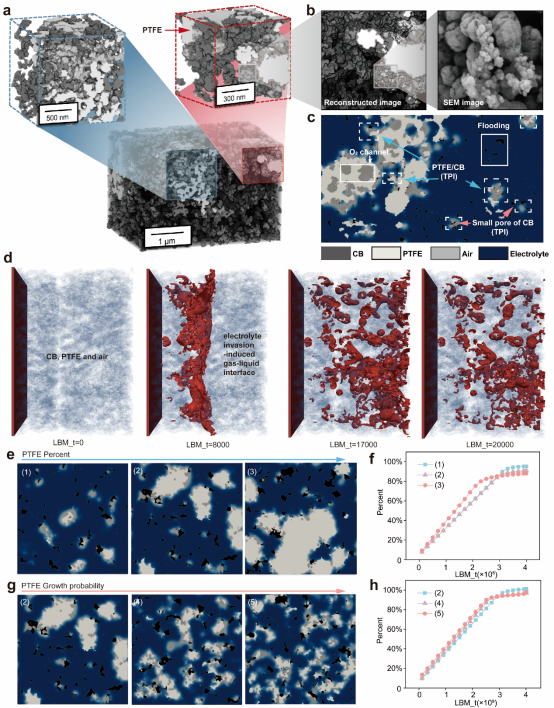
To further elucidate the mechanisms governing interface formation and maintenance, the team integrated focused ion beam–scanning electron microscopy (FIB-SEM) three-dimensional reconstruction, lattice Boltzmann simulations, and stochastic structure generation algorithms. For the first time, they quantitatively revealed the synergistic effects between “pore geometry” and “wettability contrast.”
Simulations demonstrated that hydrophilic carbon regions guide directional electrolyte infiltration, while gas-phase pathways are maintained around PTFE particles, ensuring efficient oxygen transport and interfacial stability. Based on calculations involving multiple structural parameters, the team summarized universal governing principles describing how the wettability and pore size of catalyst solid particles regulate liquid flow behavior, providing a new perspective and precise guidance for redefining pore organization strategies.
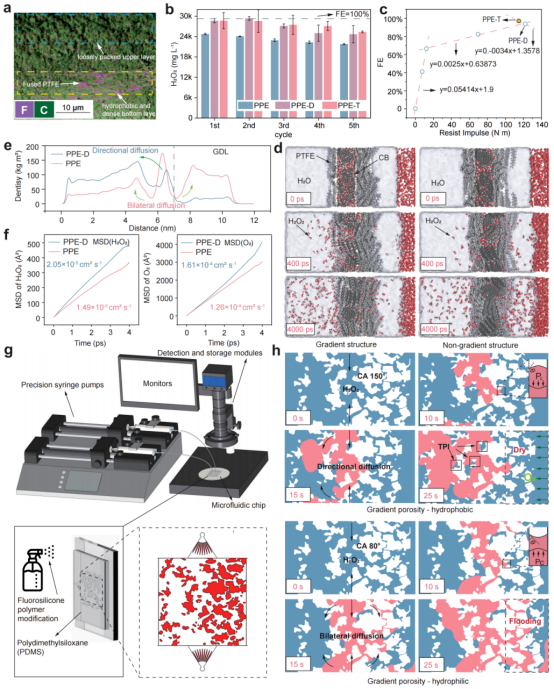
In addition to timely mass transport of reactants, efficient removal of products is also critical for maintaining the three-phase interface within the catalyst layer. Inspired by the self-transport mechanism of droplets under gradient wettability, the researchers actively regulated product migration behavior through gradient wettability engineering, constructing an electrode architecture featuring both gradient pore sizes and gradient wettability.
The strongly hydrophobic bottom layer blocks electrolyte intrusion, while the wettability gradient in the upper layer utilizes Laplace pressure differences to drive the rapid directional removal of generated H₂O₂. At the same time, it promotes reverse oxygen diffusion, significantly suppressing side reactions and enabling synergistic transport of reactants and products.
Molecular dynamics simulations and microfluidic experiments confirmed that this structure not only enables directional diffusion of H₂O₂, but also facilitates reverse oxygen replenishment, thereby significantly suppressing localized side reactions.
This research not only establishes a solid scientific foundation for the green, distributed, and low-cost electrosynthesis of hydrogen peroxide, but also provides broadly applicable guidance for solving three-phase interface challenges in a wider range of electrochemical gas-reaction processes.
Zhejiang Epai Technology Co., Ltd. has consistently adhered to its dual-wheel innovation strategy of “industry-driven development and science-driven advancement.” With industrial application of electrochemical technologies as its ultimate goal, the company simultaneously focuses on key frontier scientific challenges in the field and is committed to building an R&D system spanning from fundamental research to engineering scale-up, and from material innovation to equipment integration.